
Voluntary Export Restraints (VERs): They Backfired on the U.S. in the 1980s, and They Will Backfire on Trump Now (Potentially in Canada's Favour, Too)
I give credit to the Carney government for considering VERs in return for lower tariffs, although it needs to be repeated that we can never really trust Trump to honour his end of the bargain.

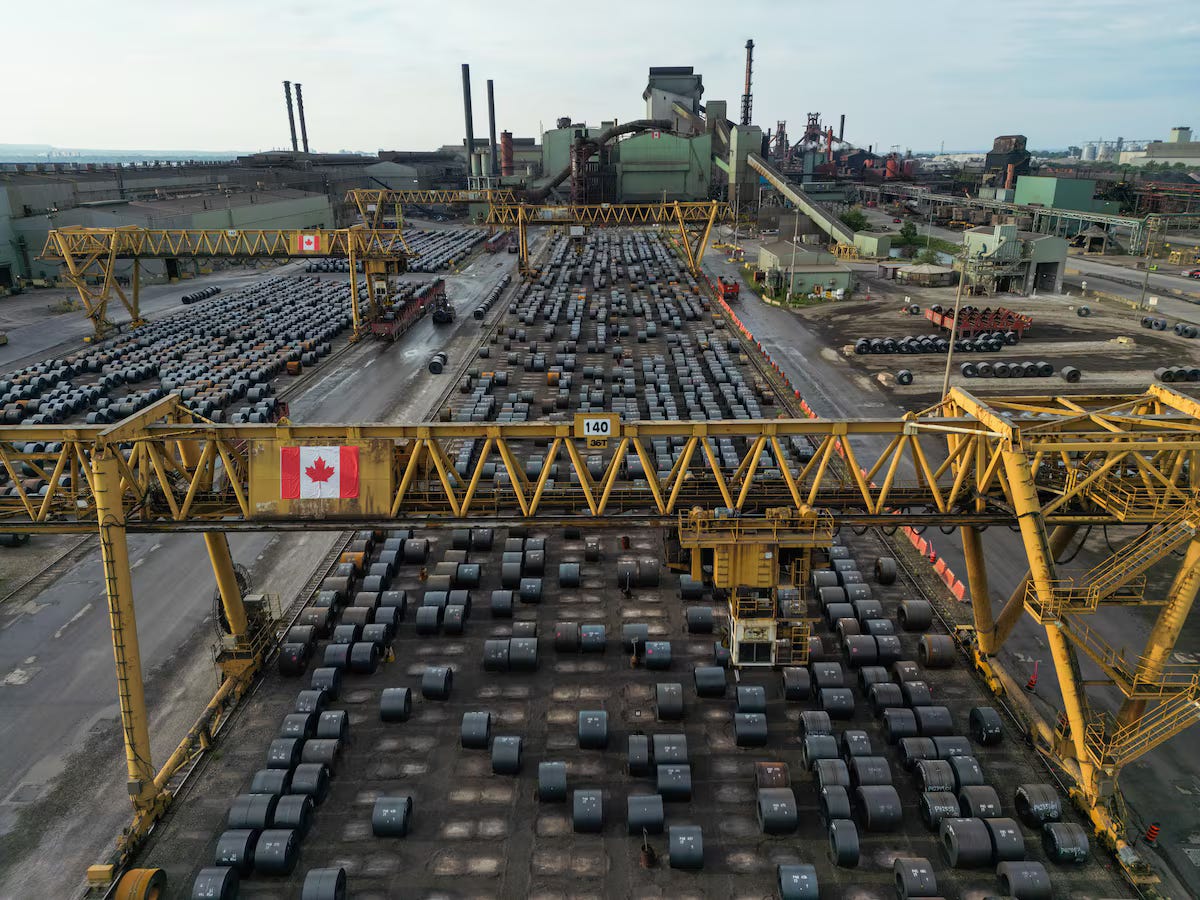
I just finished reading an interesting article written by Adrian Morrow and Mark Rendell for The Globe and Mail in which the authors report the following:
Trade negotiators are reviving a proposal that would see Canadian steel and aluminum exports subject to a quota system in return for lower U.S. levies on the metals, as the clock ticks down on President Donald Trump’s next round of tariffs.
Intergovernmental Affairs Minister Dominic LeBlanc and Janice Charette, Canada’s chief negotiator, jetted to Washington on Tuesday for the second time in as many weeks as the pressure ramps up to make a breakthrough in stalled trade talks.
…
One key to the discussions, according to four industry and two government sources, is a plan under which Canadian metals shipments to the U.S. would be limited in exchange for Mr. Trump reducing his 50-per-cent tariffs on them, similar to a proposal on the table last fall.
…
Under the framework, Canadian steel and aluminum would be subject to tariff rate quotas, or TRQs, the sources said. This would mean that only a certain amount of the Canadian metals could be exported to the U.S. before an exorbitant tariff would take effect.
Two U.S. industry sources said negotiators are still haggling over what the quotas should be and, in the case of steel, whether there should also be a lower tariff on steel sold below the quota.
In exchange, Canada would see Mr. Trump’s metals tariffs, imposed under Section 232 of the Trade Expansion Act of 1962, reduced for exports under the quota limit. Such an agreement could help achieve Canada’s central negotiating goal of easing the pain for key industrial sectors while breaking the logjam on other trade issues.
Economists call these export quotas Voluntary Export Restraints (VERs), and they are not much different from import quotas in terms of their economic effects on the importing country. However, there are still key differences which could make the exporting country even worse off than under an import tariff or import quota, and which also could make the exporting country better off than under these alternatives.
Let me explain.1
Import Quotas
An import quota is a limit on the quantity of a good that can be produced abroad and sold domestically. The WTO opposes them because tariffs are far more transparent in their application, less intrusive in the market, and less of an impediment to changing competitive conditions. Nonetheless, they still exist because:
Not all countries are members of the WTO, and they do not want to be members. Why? Because an import quota can help them deal with problems of getting enough foreign exchange to pay for imports, so they restrict imports to conserve foreign exchange.
New WTO members can keep their import quotas for a certain amount of time — a transition period, such as 15 years for Mexico when it joined the GATT in 1986.
In the context of Trump’s trade war against Canada, rather than impose a tariff where there is uncertainty regarding how much imports from Canada will actually fall, the U.S. could instead impose a quota on how much it imports.
In other words, rather than setting a tax (price increase) on imports and letting the market determine the quantity of them, the U.S. would set the quantity of imports and let the market determine the price.
As with import tariffs, import quotas generally benefit domestic producers at the expense of domestic consumers, because they raise the price of the targeted goods whether the source is domestic or foreign.
To further demonstrate the effects of import quotas on both the domestic and foreign economy, please see Figure 1 below where I assume two countries — the U.S. and Canada — and the U.S. levies an import quota on steel coming from Canada.
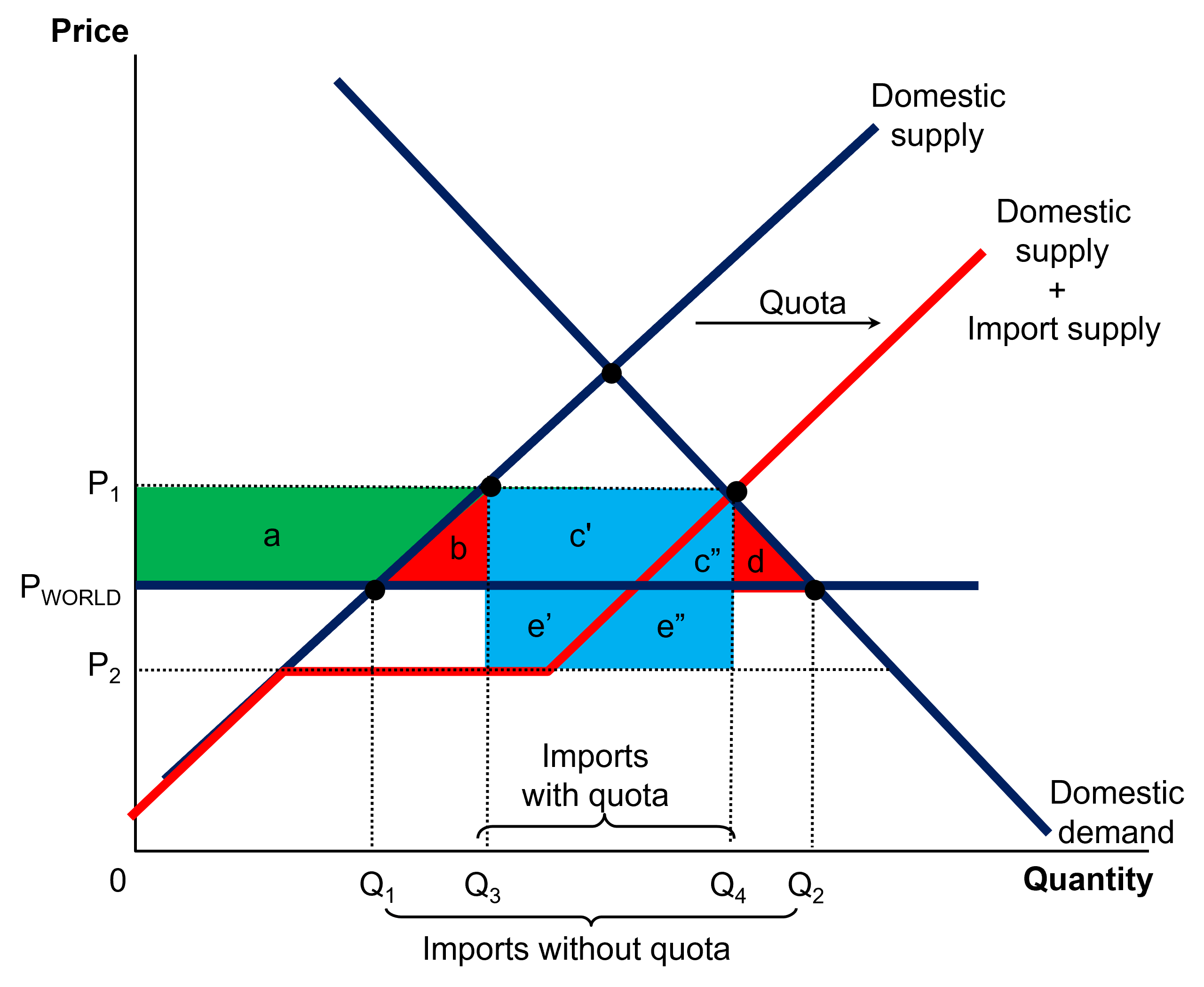
To make the analysis as easy as possible — without affecting the point of this exercise — the U.S. begins at the free-trade equilibrium where price is PWORLD. At this point, U.S. consumers buy Q2 units of steel and U.S. producers sell Q1 units of steel, and the difference (Q2 – Q1) is imported from Canada.
The U.S. then sets an import quota on Canadian steel, which causes the world price to fall because their business is important to Canadian steel producers, so we will lower our price of steel to P2 to lessen the harm of the quota on us.
Note that the more important is U.S. business to Canadian steel producers, the lower the world price will fall. If the U.S. is really super important to Canada, then the price will fall by so much that Canada will incur the entire burden of the import quota.
On the other hand, if the U.S. is entirely meaningless to the Canadian steel market, then the world price will not fall at all, and the U.S. will bear the entire burden of the import quota.
Realistically, we are both important to each other — no matter what the MAGAts say — so I assume the world price only falls enough for the two countries to share the burden of the import quota.
Now, how do we determine the new amount of imports, as well as the new domestic U.S. price of steel? This time, we actually draw a new supply curve that is also “kinky”, and this kinked supply curve is explained as follows:
The quota will cause the domestic supply curve to shift right because there is now a maximum amount that the U.S. can import of the good — there would be no shift of any curve for import tariffs, export taxes, or export subsidies as the U.S. government would not be explicitly limiting supply. The market could still supply whatever it wanted under the conditions set.
However, it will only shift at prices on or above the new world price, because if the domestic price is lower than the world price then we will not want to import any automobiles at all.
The new domestic U.S. price (P1) is determined by the intersection of the demand curve and the total supply curve: domestic supply + import supply. Consequently, U.S. consumers buy the amount where that price intersects the demand curve (Q4) and U.S. producers sell the amount where that price intersects the domestic supply curve (Q3), since they still operate on that supply curve. The difference (Q4 - Q3) is imported from Canada, which is lower than the amount imported without the quota (as intended).
Now, how does the import quota affect U.S. consumers, producers, the government, and the economy as a whole?
Since consumer surplus is represented by the entire area below the demand curve and above the price, it falls by Areas (a+b+c’+c”+d). In other words, the import quota harms U.S. consumers because they must pay more for less (Q4) steel. However, the more important is U.S. business to Canadian steel producers, the less harm will be done to the U.S. because the world price will fall more.
Since producer surplus is represented by the entire area above the supply curve and below the price, it rises by Area (a). In other words, U.S. steel producers benefit from the import quota because they can charge more for more (Q3) steel. This area also represents a mere transfer of surplus from domestic consumers to domestic producers, since someone still gets the surplus despite the import quota. Furthermore, the more important is U.S. business to Canadian steel producers, the less U.S. producers will benefit from the import quota as the world price will fall more.
The U.S. government could also earn revenues on the quota, but that is not necessarily true. That is because the simplest method of imposing the quota is for the government to give quota rights to importers (license holders), so they would be the ones to get these revenues — also known as quota rents. More on that in a moment, but like any other kind of revenue, quota rents are calculated as P*Q, so it is Areas (c’+c”+e’+e”). Areas (c’+c”) is a transfer of surplus from U.S. consumers to the quota license holders. Areas (e’+e”) is a terms of trade gain for these license holders at the expense of the Canadian market because it represents surplus that went to no one in the U.S. under free trade.
There are also distortions (deadweight losses) in the economy that amount to losses in consumer surplus which no one in the U.S. gets: Area (b) is called a production distortion because the import quota encourages U.S. steel producers to produce too much for too much. Area (d) is called a consumption distortion because it encourages U.S. steel consumers to consume too little for too much. The more important is U.S. business to Canadian steel producers, the smaller will be these distortions because the world price will fall more.
The more important is U.S. business to Canadian steel producers, the greater will be the terms of trade gain, and the smaller will be the distortions. It is therefore conceivable that the U.S. could benefit overall from the import quota when the terms of trade gain outweighs both distortions. Therefore, the optimal import quota is the one that maximizes Areas (e’ + e” - b - d).
Now, you might be asking:
Just who are these license holders?
Well, they could technically be anyone. If they are not in the U.S., then the U.S. cannot benefit overall from the import quota as it gets no terms of trade gain to outweigh the distortions; even if the distortions do not exist because the world price falls to entirely put the burden on Canada, then the U.S. is no better or worse off than with free trade.
But to give the quota rights to foreigners would be stupid and would therefore justify voting the government out of office. Nonetheless, I would not put it past Trump to give the quota rights to the Russians.
But I digress.
Anyway, let’s say the license holders are in the U.S.. Then that country can still be better off overall as long as the terms of trade gain outweighs the distortions.
But can the U.S. government instead receive these quota rents? Of course, it can! It could auction off quota rights to the highest bidders, and conceivably then take the entire quota rents represented by Areas (c’+c”+e’+e”). It could then use this revenue to help U.S. citizens harmed by the trade war, although this is Trump so he does not care about them.
However, there is a warning regarding auctioning off these quota rights: potential license holders could waste economic resources in their attempt to get these rights, such as lobbying the government for these rights. Such a waste of resources is known as rent seeking, and represents an additional loss to the economy that no one gets, much like the DWL triangles.
So ignoring rent seeking, we can see the qualitative effects of an import quota are exactly the same as those for a tariff: domestic producers benefit at the expense of domestic consumers, the U.S. government can get revenues from auctioning off quota rights, and there are two DWL triangles representing consumption and production distortions to the U.S. economy.
So why do governments focus more on tariffs than quotas? For one thing, import quotas are illegal under WTO rules primarily because they are more distortionary to the economy than an equivalent tariff. The reasoning is as follows:
If domestic demand rises — meaning the domestic demand curve shifts right — then the tariff price would remain the same, and our imports can rise to satisfy this increase in demand.
But with an import quota, imports remain exactly the same, causing the quota price to rise. Consequently, the total welfare losses to the whole economy will become larger as increased demand is met with increased domestic production.
Therefore, this is a dynamic reason why import quotas and tariffs differ.
For these reasons, when countries have historically become members of the WTO, they followed its rules by converting their import quotas — including ones used for agricultural products — to equivalent tariffs.
Let’s now move on to the primary inspiration for this article: Voluntary Export Restraints (VERs) on steel and aluminum.
Voluntary Export Restraints (VERs)
The primary difference between an import quota and a VER is with respect to which country implements it: with an import quota, the importing country restricts imports by a certain amount, while with a VER, the exporting country voluntarily reduces its own exports by a specific amount.
Therefore, there is no need to draw a new graph for a VER because it is exactly the same as for an import quota, with one primary difference: it is practically guaranteed the importing country — in this case, the U.S. — will not get the quota rents, because why would the exporting country ever give us those rents?
So in the context of Trump’s trade war, the Canadian government can voluntarily reduce our exports of steel and aluminum, and auction off the export rights so it can keep the quota rents for itself and then redistribute them to Canadians harmed by the trade restrictions.
I do not know if these rights will be auctioned off by the government, but the fact remains it is possible Canada will be less harmed by a VER than we would be if Trump imposed his own import quotas or tariffs on Canadian steel and aluminum. Thus, I give credit to the Carney government for considering VERs in return for lower tariffs, although it needs to be repeated that we can never really trust Trump to honour his end of the bargain.
Where else have VERs been used historically? A significant example involves U.S. trade of automobiles with Japan. In the 1980s when Japan was becoming a much more powerful trading partner with the U.S., the Ronald Reagan and George H.W. Bush administrations were, let’s say troubled by the negative effects of Japanese auto imports on U.S. automakers.
One way to deal with this “problem” is the Trump way: levy tariffs on imports of Japanese automobiles. But both of these Republican presidents might not have wanted to do so, perhaps because U.S. auto consumers — and voters — could more easily figure out who was to blame for rising automobile prices.
So instead, they engaged in occasional negotiations with the Japanese government to convince it to voluntarily reduce its own exports of automobiles to the U.S. — perhaps with the implicit threat that tariffs would otherwise be imposed on Japanese imports.
But it did have its funny moments, too, as during a banquet on January 8, 1992, George H.W. Bush was clearly not feeling well and vomited on the Japanese Prime Minister, Kiichi Miyazawa!
Maybe I should not laugh about it, but I do anyway. I remember it being a source of inspiration for comedians on this side of the world, such as Dana Carvey who regularly impersonated the president on Saturday Night Live.
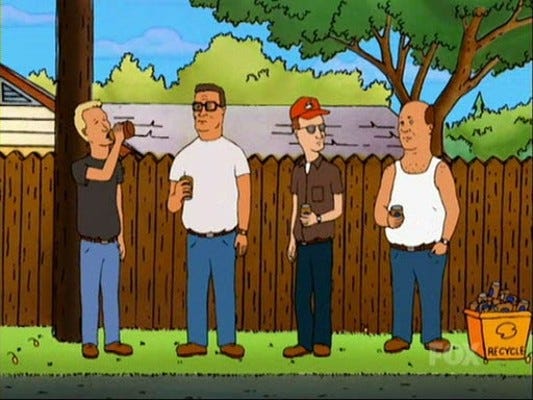
It also motivated a very funny line from Hank Hill on King of the Hill:
Detroit hasn’t felt any real pride since George Bush went to Japan and vomited on their auto executives.
But getting serious again, the VERs actually hurt the U.S. even more in the long run because they motivated Japanese automakers to set up shop in the U.S. to get around the VERs — since their automobiles were then no longer imported.
Moreover, to satisfy the persistently high demand for their automobiles, they also changed their focus away from the cheap cars they previously exported for students, and toward high-quality, feature-laden ones. In other words, the U.S. government’s push for trade restrictions only hurt its own auto industry more.
This just goes to show there are always ways for businesses to get around trade restrictions if they try hard enough. It also supports my argument that Canadian VERs on steel and aluminum are better for Canada than U.S. import tariffs or import quotas on us, but they can also easily be worse for the U.S.
In closing, I want to thank all of my paid subscribers for their subscriptions, and to encourage the rest of you to also consider paid subscriptions. I love to do research, but I also enjoy paying my bills, so a paid subscription would be very helpful in ensuring I can accomplish both.
Primary source for this article: Sawyer, W. Charles and Richard L. Sprinkle (2009). International Economics, Third Edition. Upper Saddle River, New Jersey: Pearson Education Inc.
they’ve already announced their end game is to annex, the rest imo is just theatre